Depth and perspective are essential in painting to make flat surfaces appear three-dimensional. They guide the viewer’s eye and create the illusion of space, distance, and scale. Without depth, paintings can appear flat or unrealistic. Understanding principles of perspective and techniques for creating depth allows artists to build more engaging and structured compositions.
This guide explains methods for achieving depth, how to use perspective effectively, and practical tips for painters of all levels.
Understanding Depth in Painting
Depth is the perception of space between objects in a painting. It can be physical, implied, or visual. Depth provides a sense of distance, hierarchy, and form. By controlling foreground, middle ground, and background, artists can structure the scene and lead the viewer’s attention.
Types of Perspective
Perspective is the system used to represent three-dimensional objects on a two-dimensional surface. Key types include:
- Linear perspective: Uses converging lines and vanishing points to create depth.
- Atmospheric (or aerial) perspective: Changes color, contrast, and clarity to simulate distance.
- Overlapping objects: Placing one object in front of another to suggest space.
- Size variation: Larger objects appear closer; smaller objects appear farther.
Understanding each type provides a foundation for structured composition.
Linear Perspective Techniques
Linear perspective relies on vanishing points and horizon lines. Steps include:
- Establish the horizon line representing eye level.
- Identify vanishing points (one-point, two-point, or three-point perspective).
- Draw guide lines from objects toward vanishing points.
- Position objects along guides to maintain proportion and scale.
Linear perspective organizes space logically and consistently.
Using Atmospheric Perspective
Atmospheric perspective relies on environmental factors. Techniques include:
- Color: Distant objects are cooler and less saturated.
- Contrast: Reduced contrast for far objects, higher contrast for near objects.
- Clarity: Distant shapes have softer edges and less detail.
This method creates natural depth and mimics real-world observation.
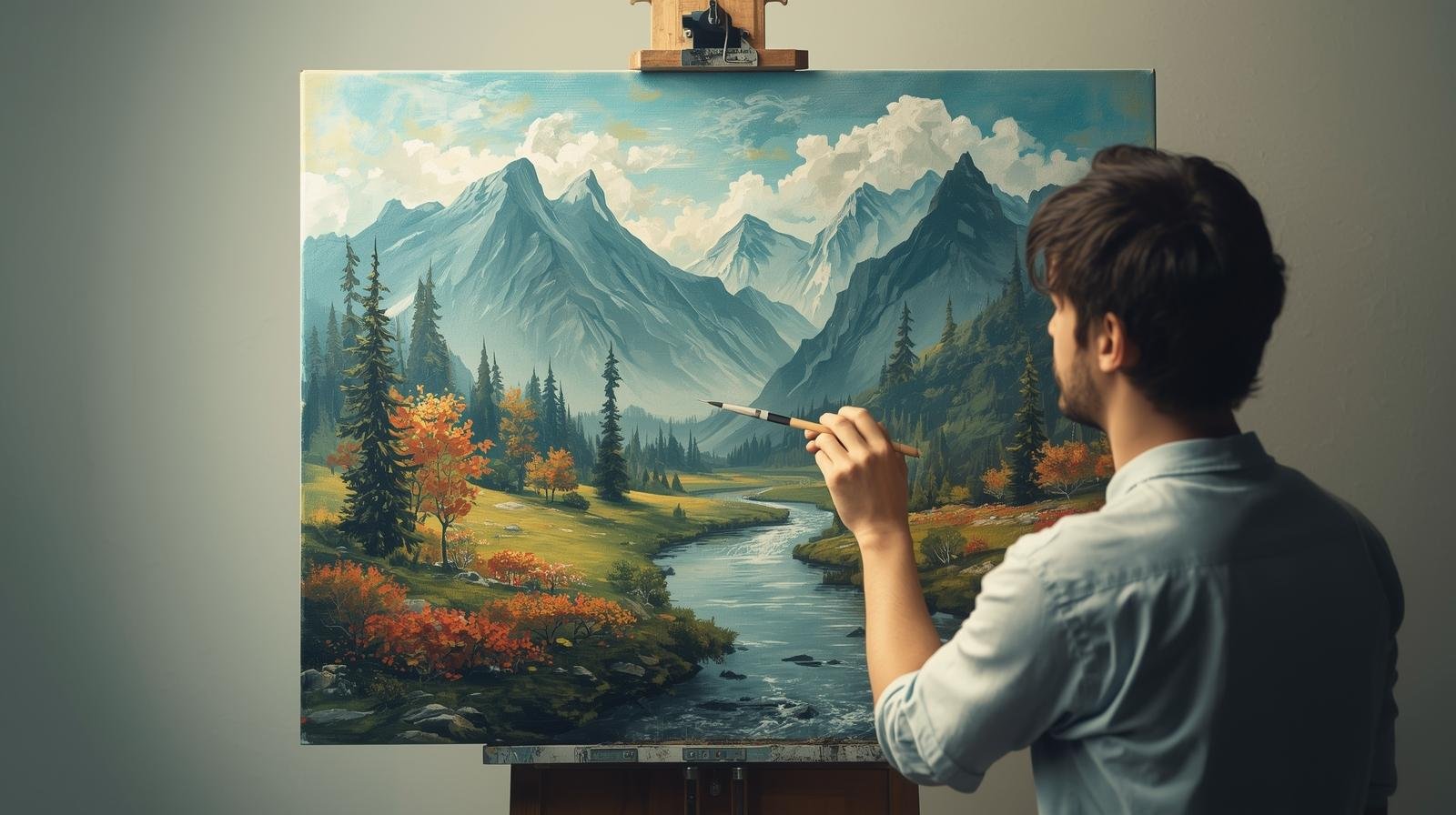
Layering Foreground, Middle Ground, and Background
Dividing a composition into layers enhances depth:
- Foreground: Most detailed and contrasting area, nearest to the viewer.
- Middle ground: Transitional space with moderate detail and contrast.
- Background: Simplified, muted, or blurred shapes to suggest distance.
This layering approach provides clarity and structure in compositions.
Overlapping Elements
Placing objects in front of others indicates spatial relationships. Overlap suggests which objects are closer without relying solely on size. Combined with linear and atmospheric perspective, it strengthens realism.
Size and Scale Adjustment
Objects decrease in size with distance. Maintaining proportional reduction ensures consistency. Misjudging scale can flatten the composition. Comparing object dimensions across layers improves spatial accuracy.
Using Shadows and Light
Light and shadow enhance depth by suggesting form and distance. Techniques include:
- Cast shadows: Show object placement relative to surfaces.
- Form shadows: Indicate curvature and structure.
- Gradients: Light-to-dark transitions reinforce volume.
Proper shadow application adds dimension and realism.
Color Temperature and Depth
Warm colors advance visually; cool colors recede. Using warm tones in the foreground and cool tones in the background reinforces spatial separation. Combining color temperature with atmospheric perspective strengthens depth perception.
Detail and Texture
Foreground objects require more detail and texture. Background elements benefit from simplified shapes and softer textures. Adjusting texture emphasizes spatial hierarchy and guides the viewer’s focus.
Overcoming Flatness
Common causes of flat paintings include:
- Ignoring perspective rules
- Using uniform color and contrast
- Placing objects without spatial logic
Applying layers, vanishing points, and atmospheric cues prevents flatness and creates engaging compositions.
Using Composition to Enhance Depth
Composition choices influence depth perception:
- Diagonal lines direct the eye and create movement.
- Curved or winding paths lead the viewer through layers.
- Framing with nearby objects reinforces foreground space.
Thoughtful composition organizes visual elements and enhances spatial perception.
Practicing Depth Techniques
Practice improves understanding:
- Draw simple cubes or boxes using one-, two-, or three-point perspective.
- Sketch landscapes applying atmospheric perspective.
- Experiment with overlapping and size variation.
- Use shadows and highlights to create form.
Repetition develops confidence and accuracy.
Integrating Multiple Techniques
Combining linear perspective, atmospheric cues, overlapping, and size variation produces strong depth. Using multiple techniques ensures balance between realism and artistic expression.
Observing Real Life
Observation is essential. Study streets, buildings, landscapes, and interiors. Note how size, color, shadow, and clarity change with distance. Real-world reference informs painting decisions and improves accuracy.
Mistakes to Avoid
Common errors include:
- Ignoring vanishing points
- Overcomplicating distant objects
- Using high contrast in background elements
Checking measurements and layers regularly prevents errors and maintains depth.
Final Tips for Beginners
- Begin with simple forms before complex scenes.
- Use light sketches to plan perspective.
- Experiment with warm and cool color transitions.
- Observe real objects for reference.
- Layer consistently to build gradual depth.
Practicing these tips ensures steady improvement.
Conclusion
Depth and perspective are essential in creating three-dimensional illusions on flat surfaces. By applying linear and atmospheric perspective, managing layers, using light and shadow, adjusting size and scale, and observing real-life references, painters can produce compositions that feel structured and realistic. Regular practice, careful planning, and attention to detail strengthen skill. Using these techniques, artists can guide viewers’ eyes, enhance engagement, and achieve spatial clarity in their work.
About the Author